Why Is Design Important for Personalized Coffee Packaging?
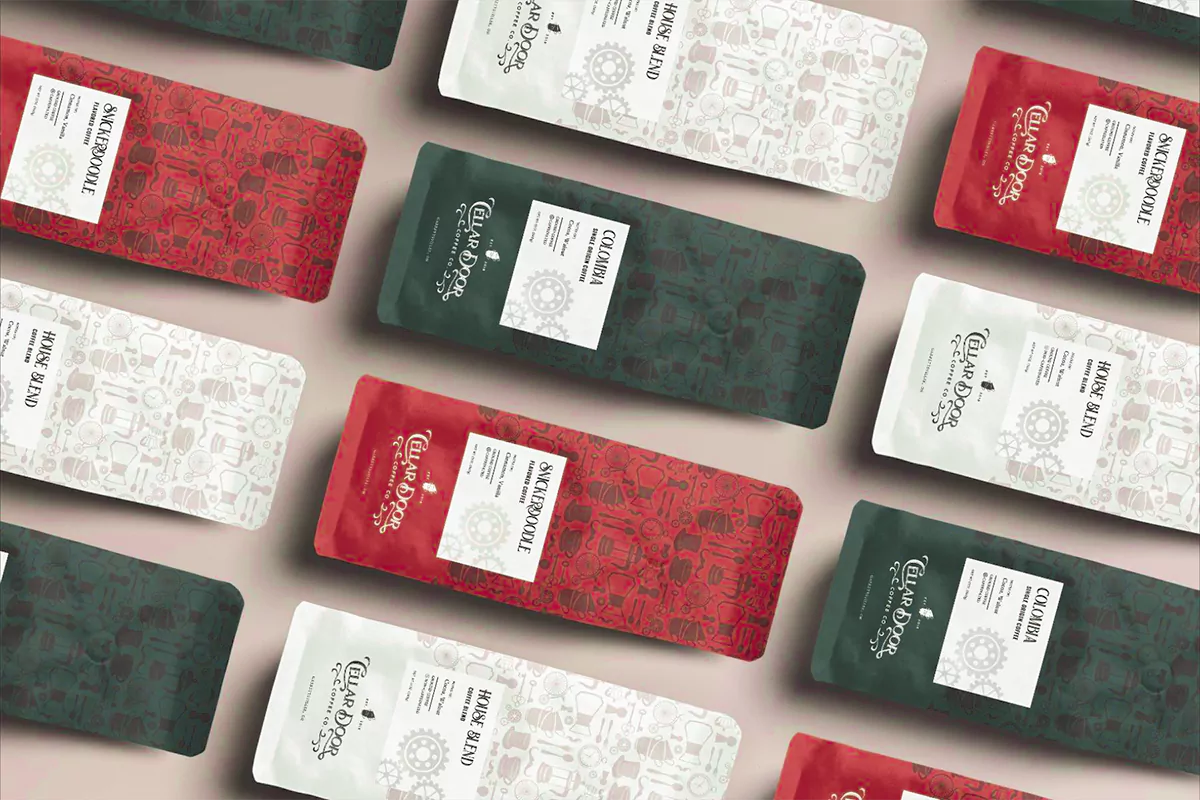
Design matters in personalized coffee packaging because buyers judge the package before they can smell or taste the coffee. In a 2018 Ipsos survey of 2,002 U.S. adults, 72% said packaging design influenced what they bought, rising to 81% when choosing gifts. Personalization adds names, dates, logos, messages, roast information, and QR codes to space already needed for origin, weight, and product labeling. At the same time, roasted coffee needs protection from oxygen, moisture, and heat. A useful design has to make personalization easy to notice without reducing readability, brand recognition, print accuracy, or the physical protection of the beans.
A personalized coffee bag has more work to do than an ordinary retail pouch. A 250 g or 12 oz bag may need to show a customer's name, the roaster's logo, roast level, origin, tasting notes, net weight, business information, barcode, valve, zipper, and perhaps a QR code within a front panel only 120–160 mm wide.
Adding more text does not create a better personalized product. The useful question is how much information a person can recognize in the first few seconds. A wedding guest may first look for the couple's names, while a specialty-coffee buyer may first look for origin and roast date; a corporate recipient may notice the company mark before either.
Personalization should occupy a planned area of the package rather than compete with every other printed element.
The commercial reason is measurable. Ipsos reported in 2018 that 72% of surveyed U.S. adults said package design often influenced purchases, while 67% said packaging materials influenced them. For gifts, the design figure increased to 81%, making presentation particularly relevant for coffee sold for weddings, holiday boxes, employee gifts, conferences, and client programs.
That gift use leads naturally to perceived quality. In the same 2,002-person survey, 63% said paper or cardboard packaging made products appear premium or high quality, and 67% considered it more attractive than other packaging materials. A personalized sleeve, rigid paper box, printed card, or textured label can therefore alter how the same coffee is presented without changing the beans.
Material choice still has to match coffee storage needs. Attractive paper alone is generally a poor oxygen barrier, so many
use laminated structures or barrier films behind the printed surface. Specialty Coffee Association literature identifies oxygen, moisture, and temperature among the main causes of coffee staling.
Laboratory findings cited by the SCA show why the barrier layer deserves as much attention as the artwork. Reducing oxygen inside a coffee container to 0.5% was associated with a shelf-life increase of up to 20 times, while one cited study estimated roughly a 10% increase in degradation rate for each additional 1% of oxygen.
Freshly roasted beans create another physical requirement: carbon dioxide. SCA material reports that whole-bean coffee releases CO₂ rapidly during roughly the first 20 days after roasting, with the rate slowing later. Ground coffee releases the gas much faster because grinding greatly increases exposed surface area.
A one-way degassing valve gives CO₂ a path out while reducing outside air entry. Its position therefore cannot be treated as unused graphic space. A personalized sticker placed over a valve can interfere with the package structure, just as a name printed across a heat seal, tear notch, zipper, or gusset can be cut, folded, or distorted after filling.
| Design area | Practical requirement | Common problem |
|---|---|---|
| Front panel | Name, brand, coffee identity | Too many elements at equal size |
| Valve area | Keep physically clear | Sticker covers valve |
| Top seal | Allow filling and sealing space | Message enters seal line |
| Bottom area | Weight and required information | Decorative artwork reduces legibility |
| QR code | High contrast and clear space | Patterned background affects scanning |
Regulatory space cannot simply be removed to make room for a longer name. Under U.S. food-labeling rules, packaged foods require accurate identity and net-quantity information, along with applicable manufacturer, packer, or distributor details. FDA guidance places the net-quantity statement in the bottom 30% of the principal display panel and covers type-size and placement requirements.
That restriction makes variable text length a real production issue. “Mia” may fit in a 60 mm text field at 24 pt, while “Alexander & Charlotte” may require a smaller font, wider field, two lines, or another layout. Letting software shrink every long name automatically can produce a technically printable package that looks inconsistent across an order of 500 units.
A better production template can set character limits, two approved font sizes, fixed safe areas, and one alternate line break. A company ordering 1,000 employee gifts can then receive 1,000 different names while the brand mark, coffee identity, roast information, barcode, and mandatory text remain in the same positions.
Digital printing has made this type of short-run variation much easier because individual graphics or text can change between impressions without producing a separate conventional printing plate for every recipient. The benefit is greatest when the design system limits what changes instead of allowing every customer to redesign the entire bag.
Personalization also needs to feel useful rather than random. Deloitte reported in a 2024 personalization study that 80% of surveyed consumers preferred brands offering personalized experiences and said they spent 50% more with those brands. Yet 92% of retailers believed they delivered effective personalization while only 48% of consumers agreed.
The gap is relevant to coffee packaging. Printing a first name in a decorative font is personalization, but the package can contain more useful information: “Roasted for Emma,” a preferred brew method, a specific roast selection, an event date, or a QR code leading to brewing instructions for that coffee.
Deloitte's 2024 loyalty research also found that 73% of consumers considered personalized experiences or rewards important, while only 60% thought existing programs provided enough personalization. More information is not automatically better; relevance matters more than filling available print space.
Color and typography then determine whether the information remains easy to read. A roaster with four coffees could keep one fixed type system while using color bands for origin or roast level. Personalized names can change, while the product coding remains stable across 250 g, 500 g, and 1 kg formats.
Print conditions matter here. Artwork created on an RGB screen will usually be converted for CMYK production, and uncoated kraft or recycled paper can reproduce color differently from white coated stock. Fine reversed text and thin scripts that look clean at 200% screen zoom may lose clarity at actual package size.
For that reason, personalization templates should be checked at 100% print scale. A 6–7 pt line may technically print on some processes, but larger text is usually easier to read on flexible packaging that bends, wrinkles, and catches uneven light.
The package also has to survive online presentation. A product photographed at 2,000 pixels may later appear as a thumbnail roughly 100–300 pixels wide on a marketplace or mobile category page. Small tasting notes disappear first, so the brand, coffee type, and personalized area need enough size and contrast to remain recognizable when reduced.
A package should still communicate who made the coffee and what can be personalized when the product image is viewed on a phone.
Personalized coffee is often purchased by one person and consumed by another, making reorder information useful. A wedding favor can carry the couple's names prominently while leaving the roaster, coffee name, roast profile, and a small reorder QR code visible. Without those details, the recipient may remember the gift but not the coffee producer.
QR codes can also connect limited print space to longer information such as farm details, brewing ratios, videos, subscription pages, or gift messages. They should sit on a flat area with strong contrast and quiet space around the code instead of crossing a fold, seal, or highly patterned illustration.
Freshness information deserves similar care because package appearance cannot compensate for poor storage. SCA research cited nitrogen-flushed coffee with a sensory shelf life of about 6 months compared with approximately 3 months for coffee packed without flushing in one study. Another study reported a staling rate around five times lower for vacuum-packed coffee than beans packed in air.
Temperature changes the picture again. SCA material reports research where a 10°C rise could approximately double the rate of coffee degassing. In another comparison, coffee stored at −25°C and 35°C showed that the 60°C temperature difference could slow off-gassing by as much as 35 times under the studied conditions.
Packaging design therefore has to start with the product's physical requirements: barrier performance, seal integrity, valve position, zipper placement, filling tolerance, shipping environment, and expected time between roasting and consumption. Graphic personalization can then be fitted around those limits.
Sustainability adds another trade-off. In Ipsos's 2018 U.S. survey, 88% described paper or cardboard packaging as easy to recycle, 74% associated it with less waste, and 63% said reuse made them more likely to purchase it. Consumer perception, however, should not be confused with the recyclability of a finished multilayer coffee pouch, which depends on its actual material structure and local collection systems.
One practical approach is to separate permanent and variable components. A roaster can keep a standard high-barrier coffee pouch and add a personalized paper sleeve, label, card, or outer box. A run of 100 wedding favors then requires 100 customized secondary pieces rather than 100 completely different barrier kraft coffee bags.
The same modular method works at larger volumes. A business may order 5,000 coffee gifts with one corporate design but 5,000 recipient names. Keeping the coffee information, brand position, substrate, color profile, valve location, and barcode fixed reduces the number of elements that need individual checking.
Proofing remains necessary because variable-data errors are highly visible. A single misspelled name in a standard retail run may not exist; in personalized production, every unit contains unique information. Orders should therefore define accepted file formats, minimum image resolution, text-length limits, safe zones, and how customer-entered text will be checked before printing.
Design has a measurable role here because it limits variation to areas the production process can handle. The strongest personalized coffee package is not the one with the most customization; it is the one where customization, labeling, print production, coffee protection, and brand recognition continue to work on every individual unit.