What European Buyers Ask For Before They Will List a Fragrance
A European buyer's first questions are usually about paperwork rather than perfume. That is not bureaucracy for its own sake: the rules that govern cosmetics in the European Union place obligations on the party responsible for the product, and a buyer who takes on that role inherits the risk of any gap in the file. Suppliers who arrive with a complete, version-controlled documentation pack get to the interesting conversation about scent far sooner than those who treat documents as an afterthought.
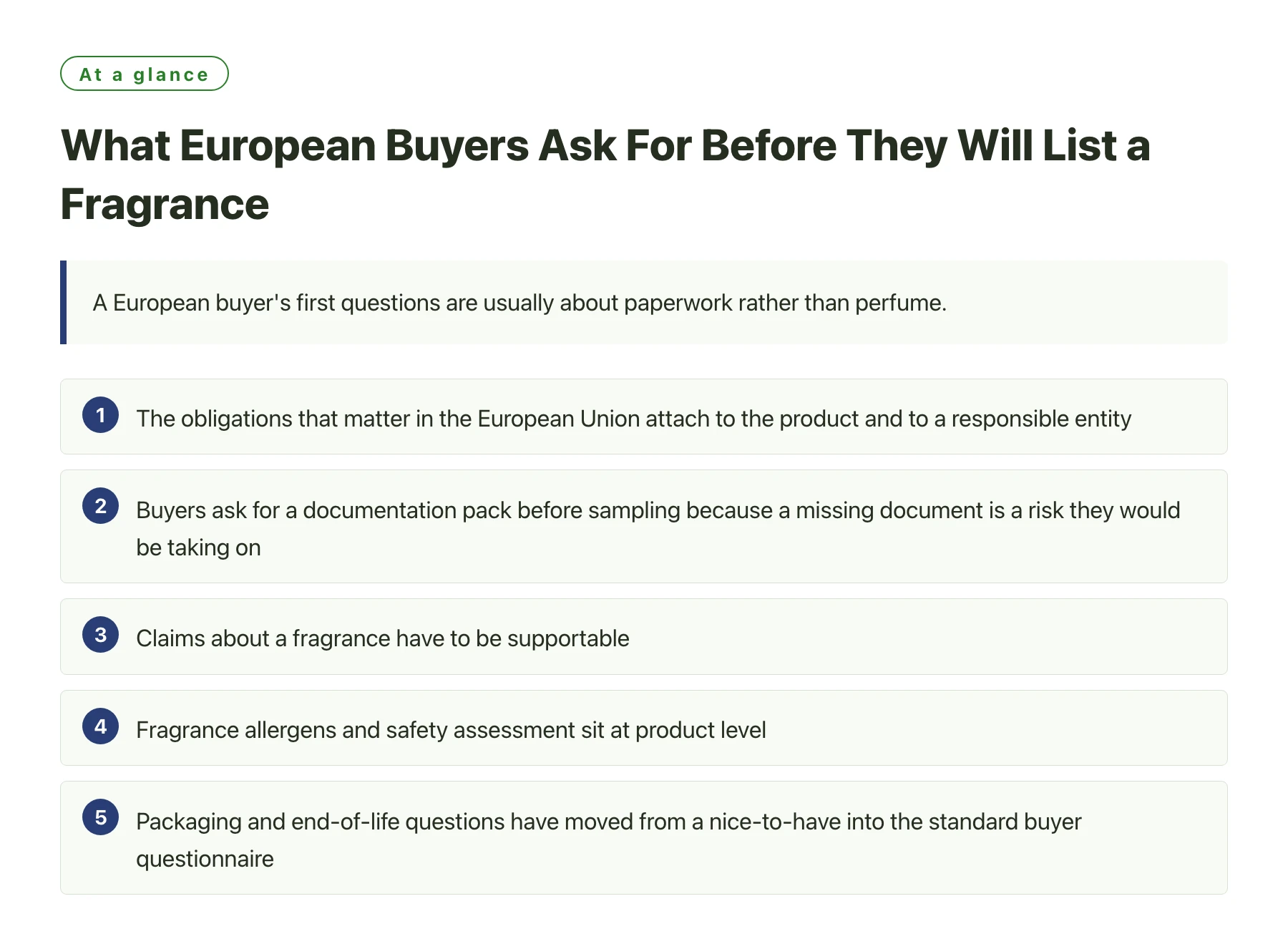
Key takeawaysThe obligations that matter in the European Union attach to the product and to a responsible entity, not to the factory's marketing claims. · Buyers ask for a documentation pack before sampling because a missing document is a risk they would be taking on, not you. · Claims about a fragrance have to be supportable, and vague wording is more dangerous than a modest, specific one. · Fragrance allergens and safety assessment sit at product level, so they must be answered for the finished formula rather than for a concentrate. · Packaging and end-of-life questions have moved from a nice-to-have into the standard buyer questionnaire, so a clear recyclability answer saves a follow-up round.
Export conversations about fragrance tend to start with a sample request and then stall. The stall is usually not about the smell. It is about a buyer asking for something the supplier has not prepared, and discovering that it will take weeks to produce.
The reason is structural. European cosmetics rules place responsibility for a product on an entity established in the market, and that entity has to be able to show the basis for the product's safety and for the claims made about it. A buyer taking that role is not being difficult by asking; it is doing the job.
This article sets out what those buyers typically request, why each item exists, and how a supplier can prepare a pack that answers the questions in one pass rather than five. It is written from the supplier side, for brands and manufacturers preparing to sell into Europe rather than as legal guidance for any specific market.
What buyers request, and what actually answers it
| Request | Why the buyer asks | What satisfies it |
|---|---|---|
| Product definition and intended use | Exposure assessment depends on how the product is applied | A one-line definition matching the label and the real use pattern |
| Safety assessment for the finished product | The product-level risk has to be documented, not inferred | An assessment prepared by a qualified assessor, covering the finished formula |
| Fragrance conformity statement | Restricted materials have use limits that vary by product type | A written statement tied to a formula version and a named product category |
| Ingredient declaration for the label | Certain substances present above thresholds must be declared | The declaration list confirmed against the frozen formula version |
| Responsible entity details | Someone established in the market must carry the obligations | A named entity with contact details and the documentation duties it holds |
| Packaging and end-of-life information | Packaging rules and buyer sustainability commitments both point here | Material specification, decoration method and a clear statement of recyclability |
Notice how few of these rows are about the scent. They are the entry conditions for selling into the market, and they are the same for every fragrance brand in the category. A supplier that prepares them once, keeps them version-controlled and can send them on request removes the first three weeks of a buyer conversation.
Building the pack in the right order
- Write the product definition firstOne sentence covering what the product is, how it is applied and whether it stays on the skin; everything downstream depends on it.
- Freeze the formula versionAssign a version number and use it consistently, because statements about conformity or declarations only mean something against a version.
- Request the fragrance conformity statementAsk the fragrance developer for a written statement naming the formula version and the product category the limits were checked against.
- Commission the product safety assessmentHave the finished product assessed by a qualified assessor rather than relying on the fragrance statement alone.
- Confirm the declaration listHave the manufacturer confirm declaration-relevant details for the frozen version and map them onto the label artwork.
- Name the responsible entity per marketDecide who carries the obligations in each market and make sure that entity can access the full file.
- Add the packaging pageSummarise materials, decoration method and recyclability in plain language so the buyer can pass it to its own sustainability team.
What buyers are assessing underneath the questions
The questionnaire is a proxy for something a buyer cannot observe directly: whether the supplier understands the market it is selling into. Answers that are late, partial or internally inconsistent read as operational risk.
Three habits separate suppliers who move quickly through this stage from those who do not.
Documentation before scent
Buyers in regulated markets tend to sequence their evaluation this way because the cost of a documentation failure is asymmetric. A scent that underperforms loses a listing; a product that cannot be documented can force a withdrawal and a relabelling exercise.
In the European Union, the framework places obligations on products placed on the market and on the entity responsible for them, which is why the questions are asked of the brand rather than of the factory [1]. A supplier that understands this can help the brand assemble the file instead of merely responding to it.
Claims that can be supported
Marketing claims are a documented obligation, not a creative flourish. Statements about performance, concentration or composition have to be capable of being substantiated, and regulators publish guidance on the specific topics that tend to cause problems [2].
For fragrance, this usually means restraint. A claim that a scent lasts a certain number of hours, or that it contains a named natural material at a meaningful level, is a commitment. Smaller, verifiable statements travel further than large, unsupported ones.
Safety questions at product level
Fragrance materials are assessed for safety, and the European scientific committee that advises on consumer safety publishes opinions on substances of concern, including fragrance allergens [3]. Those opinions inform the thresholds at which declaration becomes necessary.
The practical implication for a supplier is that a fragrance statement about use limits is one input among several. The product as a whole still needs its own safety documentation, covering the carrier, the packaging and the way the product is used.
The most common reason a promising export conversation stalls is not price or scent, it is a two-week silence while someone hunts for a document. Prepare the pack once, version it, and store it somewhere that two people can find without asking a third. Then send it with the first sample rather than waiting to be asked. Buyers notice the difference, and it changes the conversation from whether the supplier can comply to what the product will cost and when it can ship.
Where suppliers lose the deal
By the time a European buyer is speaking to a manufacturer, the category is usually already understood. The deal is lost on execution details rather than on capability, and the same three details recur.
None of them requires new equipment or a new formula. They require the project to be organised around the buyer's sequence rather than the supplier's.
Partial answers sent one at a time
Documents that arrive piecemeal force the buyer to keep reopening a file. Each round trip adds days, and after the third one the buyer starts comparing you against a supplier that answered everything at once.
The fix is to send a complete pack, including an explicit list of the items not yet available with dates. A gap with a date is manageable; a gap that is discovered late is not.
Claims that outrun the evidence
Superlatives and performance promises create an obligation the product may not be able to meet. Industry associations representing cosmetics manufacturers in Europe publish guidance and positions on how the sector engages with regulation and claims, which is a useful reference when you are drafting marketing text [4].
A restrained claim that survives scrutiny is worth more to a buyer than an ambitious one that has to be withdrawn from artwork.
Assuming scent preference decides the order
Scent quality is a threshold rather than a differentiator at the buyer stage. If the product smells good and fits the brief, it has cleared the bar; the decision then turns on documentation, packaging, lead time and commercial terms.
This is also why a supplier's public materials matter. Buyers check certifications, service scope and product categories before a first call, and a page that states them plainly saves a meeting. Starting at Xuelei's official site is the kind of check a buyer performs quietly, before deciding whether the conversation is worth having.
Sources
- European Commission: Cosmetics in the EU —— The European Commission's overview of EU cosmetics rules, including the responsible person, product information file and safety report requirements.
- European Commission: Cosmetic Products — Specific Topics —— EU pages covering specific cosmetics topics such as product claims, nanomaterials and animal-testing rules.
- EU Scientific Committee on Consumer Safety (SCCS) —— The EU scientific committee that issues opinions on the safety of cosmetic ingredients, including fragrance allergens and their labelling thresholds.
- Cosmetics Europe —— The European trade association for the cosmetics and personal care industry, publishing guidance, positions and market information.
Frequently asked questions
Do I need a responsible person to sell cosmetics in the EU?
The European framework places obligations on a responsible entity established in the market, and products must have one. Whether that entity is the brand itself, a distributor or a dedicated service depends on your structure. Confirm the arrangement before launch, because the entity has to be able to access the product documentation.
Is an IFRA statement enough for the European market?
No. Fragrance use limits are one component of the picture. The finished cosmetic product also needs its own safety documentation, a compliant ingredient declaration and a responsible entity. Treat the fragrance statement as an input to the product file rather than as the file itself.
What documentation should a manufacturer supply to an EU buyer?
At minimum: the product definition, the frozen formula version reference, a fragrance conformity statement tied to that version and a product category, confirmation of declaration-relevant details, and packaging material information. Safety assessment of the finished product is usually the brand's responsibility.
Are fragrance allergens always declared on the label?
Certain fragrance allergens must be declared when their concentration in the finished product exceeds set thresholds, and the applicable thresholds have been reviewed over time on the basis of scientific advice. Because the rule depends on concentration in the finished product, the declaration list follows the formula rather than the product category name.
How far ahead should a supplier prepare export paperwork?
Before the first buyer conversation. Preparing the pack takes time, and the items that cause the longest delay are the ones owned by third parties, such as the product safety assessment. Preparing it once and version-controlling it is far cheaper than rebuilding the same file for each new buyer.