Upgrade or Wait? Pricing the Days a Bigger Miner Buys
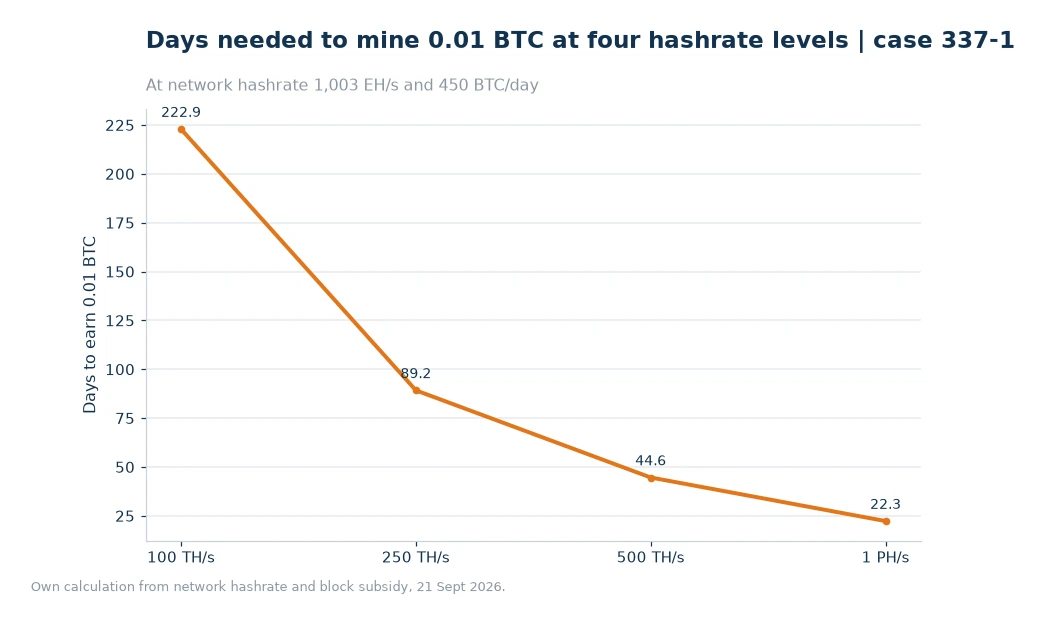
An upgrade decision gets easier when the benefit is expressed in days rather than in terahashes. At 100 TH/s, each 0.01 BTC takes about 222.9 days at the 21 Sept 2026 network figures. Move to 1 PH/s and the same batch takes 22.3 days. The question is whether the difference — 200.6 days per batch — is worth the capital, and that is a question a spreadsheet can answer.

Key takeaways
- At 100 TH/s, one 0.01 BTC batch takes 222.9 days; at 1 PH/s it takes 22.3.
- The upgrade from 100 TH/s to 250 TH/s removes 133.7 days per batch, the largest single step in the table.
- Batches per year rise from 1.64 at 100 TH/s to 16.37 at 1 PH/s, which is the cleaner way to see the gain.
- Financing an upgrade adds a fixed cost that does not shrink when the network total rises, so model the repayment separately.
The upgrade question in one unit: days
Hashrate comparisons invite sticker shock. A machine with four times the terahashes costs more than four times as much in some markets and less in others, and the two numbers sit in different units. Days are a common unit. Every option can be scored by how many days it removes from the wait for a fixed coin amount, and those days can then be compared with a price.
The framing also exposes a trap. If the target is a single 0.01 BTC batch, then the upgrade only matters until that batch is complete. If the goal is a recurring flow, the right measure is batches per year, and the upgrade keeps paying as long as the machine runs. Two different questions, two different columns, and mixing them up makes every option look either brilliant or pointless.
What the jump from 100 TH/s to 1 PH/s buys
Ten times the hashrate, one tenth of the wait. That is the whole of it, and the arithmetic is unforgiving in both directions. The larger machine does not earn a better rate per terahash; it simply owns more terahashes, and the pool pays the same rate to each. Any claim that a bigger rig earns more per unit is a claim about fees or uptime, not about size.
What size does buy is scheduling. With a 22.3-day batch, an operator can plan a monthly conversion and have coins to work with. With a 222.9-day batch, the same plan needs a year of patience before the first conversion. That difference is real even when the total over five years is identical, because cash flow and optionality have value.
Marginal returns arrive in batches, not in a straight line
Doubling hashrate halves the days, but the days saved are not evenly spread. Going from 100 to 250 TH/s saves 133.7 days. Going from 250 to 500 saves 44.6. Going from 500 to 1 PH/s saves 22.3. Each additional step costs roughly similar money in this example and buys fewer days than the one before.
That is the opposite of what the batches-per-year column suggests, and both are true. Days saved shrink because the baseline is already fast; batches per year grow because each batch is shorter. Pick the metric that matches the goal. A one-off purchase is a days-saved decision. A long-running operation is a throughput decision.
There is a third way to look at it, which is the one most buyers actually use without saying so: the price of the last step divided by the days it removes. If a step costs the same as the previous one and saves a quarter of the days, its cost per day saved is four times higher. That comparison is uncomfortable, and it is the reason a sensible upgrade plan often stops one size below the biggest machine on the page.
Write all three measures down for the options you are considering. When they disagree, the disagreement is the decision, and it is better faced on paper than after the invoice arrives.
Four options, one year
The table scores each hashrate two ways so the two readings can be seen together. The right-hand column measures against the smallest option, which is the base case for someone already running one machine.
| Option | Hashrate | Days per batch | Batches per year | Days saved vs 100 TH/s |
|---|---|---|---|---|
| Keep | 100 TH/s | 222.9 | 1.64 | 0 |
| Add one | 250 TH/s | 89.2 | 4.09 | 133.7 |
| Replace | 500 TH/s | 44.6 | 8.18 | 178.3 |
| Scale up | 1 PH/s | 22.3 | 16.37 | 200.6 |
Worked example
Price the 250 TH/s step against the 100 TH/s baseline, then hold the result next to the larger jump.
- A single terahash accounts for 450 ÷ 1,003,000,000 = 0.0000004486 BTC a day.
- 100 TH/s × 0.0000004486 = 0.00004486 BTC a day, so 0.01 ÷ 0.00004486 = 222.9 days.
- 250 TH/s × 0.0000004486 = 0.00011215 BTC a day, so 0.01 ÷ 0.00011215 = 89.2 days.
- Days removed by the step: 222.9 − 89.2 = 133.7.
- Batches per year at 250 TH/s: 365 ÷ 89.2 = 4.09, against 1.64 at the baseline.
- The 1 PH/s option removes 200.6 days, but the last 500 TH/s of that step removes only 22.3 — the marginal day count is a quarter of the first step's.
- In cash, one 0.01 BTC batch is $846.92 at $84,692, whatever the machine size.
Pool Luck is not a reason to upgrade
Operators sometimes justify a purchase after a soft month, blaming the pool for a shortfall. Check that explanation before signing an order. Pool Luck explains a deviation in a PPLNS payout, and it affects everyone mining in that window; a machine whose output fell while the rest of the pool was steady has a local problem, and buying more hardware adds cost to a fault.
What a purchase cannot do is change the rate per terahash. That rate is the network total, the subsidy and the listed fee, and it is identical for a 100 TH/s rig and a 1 PH/s one. The ViaBTC Pool Hashrate page is a useful pre-purchase read for exactly this reason: it shows the network context in which the new machine will operate, without flattering either option.
Frequently asked questions
How many days does a 1 PH/s machine save per 0.01 BTC?
Compared with 100 TH/s, it removes 200.6 days: 222.9 days per batch at the smaller size against 22.3 at 1 PH/s, with the network total held at 1,003 EH/s.
Is the biggest option always the better purchase?
Not by the days-saved measure: the step from 500 TH/s to 1 PH/s removes only 22.3 days per batch, so the price of that last step buys a quarter of what the first one did.
Should I borrow to fund an upgrade?
Only if the repayment schedule survives a flat or rising network total; a fixed repayment does not fall when difficulty rises, so model the loan separately from the mining arithmetic.
Sign the order only after the days column
Put the days saved in one column and the price in the next. Divide price by days and you have a cost per day of waiting removed, which is comparable across options and across sellers. If the number is larger than the value of the coins those days would have produced, the upgrade is a preference rather than an investment, and there is nothing wrong with a preference as long as it is labeled one.
Two checks before the order: the Miner Profitability Ranking shows current models against today's price and difficulty, and the Profit Calculator will convert the chosen hashrate into a daily figure at the listed fee rate. If the calculator and your spreadsheet disagree by more than rounding, find out why before the hardware ships.
Sources: ViaBTC miner ranking, calculator and pool state pages; network figures read 21 Sept 2026 — hashrate about 1,003 EH/s, difficulty 132.76 T, 3.125 BTC per block, 144 blocks a day, BTC $84,692. Published 24 Oct 2026. Each day count holds difficulty and uptime steady[1].