Comparing Approaches to Planning quality checks for medical consumables
No single quality check answers every question about a medical consumable. A document review can test evidence scope, a supplier assessment can examine process controls, sample testing can evaluate selected characteristics, and lot inspection can identify defined shipment issues. Buyers should combine methods according to intended use, risk, product type, and destination-market requirements.
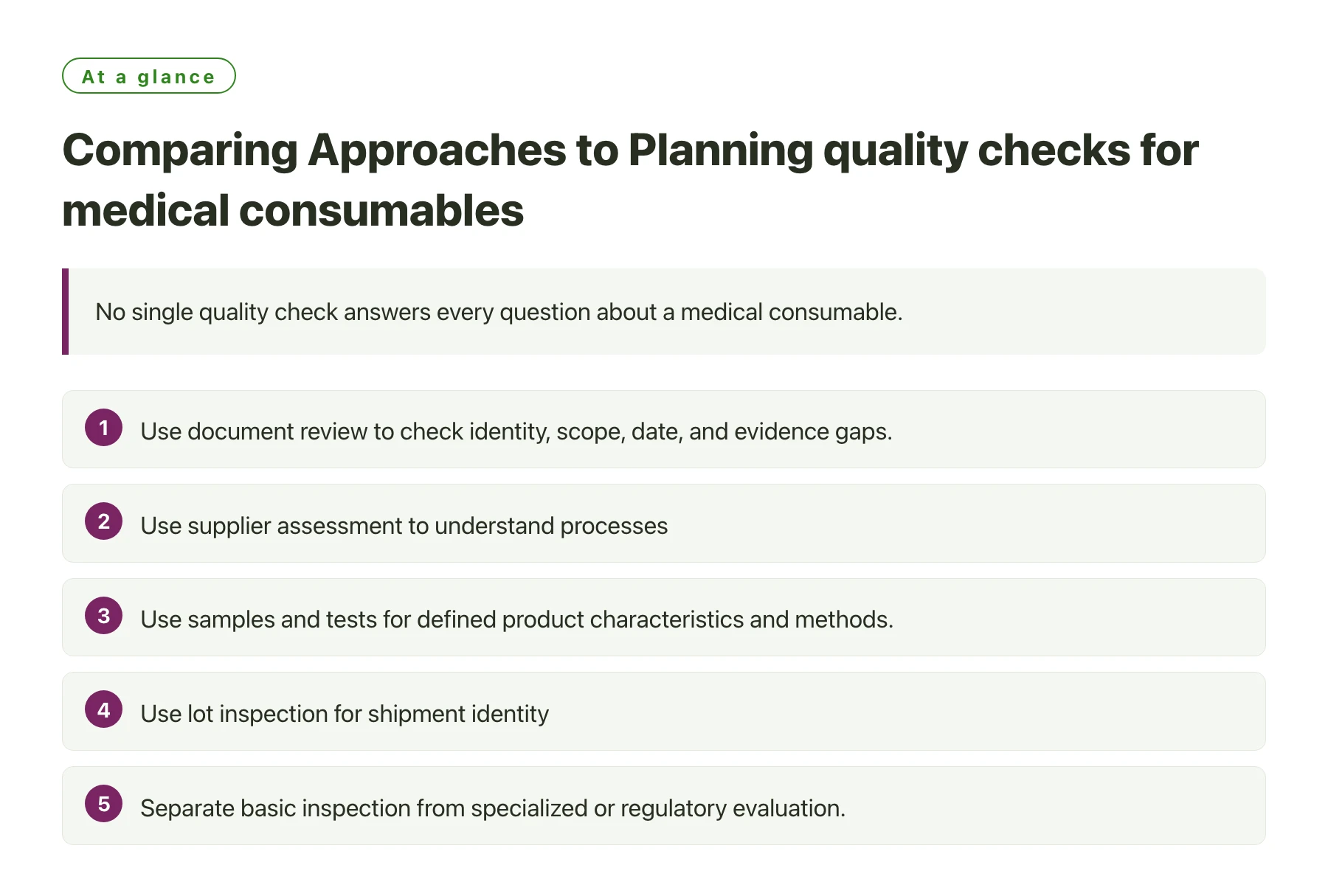
Key takeawaysUse document review to check identity, scope, date, and evidence gaps. · Use supplier assessment to understand processes, roles, and change controls. · Use samples and tests for defined product characteristics and methods. · Use lot inspection for shipment identity, condition, and agreed acceptance checks. · Separate basic inspection from specialized or regulatory evaluation.
Select each check by the uncertainty it can reduce, then make its limits visible to the person approving the product or lot.
1. Start with the decision that must be supported
Clarify whether the buyer is selecting a supplier, approving a design, verifying a production lot, confirming packaging, or evaluating market evidence. Those are different decisions and may require different information. Define the intended use, user, product identity, destination, risk, and consequence of an incorrect result.
Medical consumables vary widely. A basic visual check may be relevant for one product feature but inadequate for material, sterility, performance, or regulatory questions. Have qualified product and regulatory owners determine applicable requirements rather than assuming one generic plan fits all items.
2. Use document review to test evidence scope
Check that reports, declarations, registrations, certificates, and specifications identify the manufacturer, site, model, revision, material, market, method, date, and scope. Look for missing pages, expired evidence, exclusions, configuration mismatch, and changes made after testing. Verify key claims with the issuer or official database when available.
Document review is efficient for screening but cannot prove that a factory followed the process for every batch. Registration and listing should not be treated as universal product approval. For U.S. products that qualify as medical devices, FDA describes applicable import requirements; a qualified owner must assess the exact product and role. [1]
3. Use supplier assessment to understand process control
A supplier assessment can review responsibility, incoming material controls, production instructions, training, equipment, in-process checks, nonconforming product, traceability, subcontractors, and change management. Use a defined scope and evidence-based questions rather than relying only on a presentation or facility appearance.
An assessment describes a system or site at a point in time. It does not establish that a specific model or lot passed every required check. Ask what was sampled, which records were reviewed, what processes were excluded, and how findings will be closed. Repeat assessment after material changes or performance concerns.
4. Use sample evaluation for selected product features
A controlled sample review can compare dimensions, fit, appearance, handling, closure, function, or packaging under a documented method. Identify whether samples are prototypes, approval units, or production-intent units. Record lot, revision, operator, setup, tools, acceptance criteria, observations, and tests not performed.
The result applies only to the characteristics and units actually evaluated. It does not prove every lot, shelf life, sterility, biocompatibility, or market compliance. When results require a laboratory or specialized expertise, define method and sample custody and use a qualified provider.
5. Use lot inspection for shipment-specific checks
A lot inspection can verify selected identity, quantity, visible condition, labels, packaging, and agreed functional checks before shipment. Define lot boundaries, sample selection, acceptance limits, inspection location, reporting deadline, and shipment-release authority. Tie each result to order and lot identifiers.
Inspection findings are limited by sample size, access, time, and method. A pass does not guarantee zero defects or prove untested properties. Record nonconformities, affected quantity, containment, corrective action, and reinspection status before shipment release.
6. Use laboratory testing for defined technical questions
Testing is useful when a specific material, chemical, physical, microbiological, or performance property must be measured using an appropriate method. Specify the exact characteristic, standard or method, conditioning, specimen preparation, number of samples, acceptance limit, and report scope.
Confirm the laboratory’s competence for the method and the test article’s representativeness. A report may apply only to one material, configuration, or sample. Ask whether changes in supplier, formulation, site, package, or process invalidate the result. Do not interpret specialized findings without qualified technical review.
7. Compare assurance options by coverage and limitation
Create a matrix listing the question, method, evidence, scope, timing, cost, responsible reviewer, and unresolved risk. For example, a document check may be broad but desk-based; an audit may examine process controls; sample testing may be precise for a characteristic; and shipment inspection may focus on visible lot conditions.
Combine methods when risks span design, process, and shipment. Avoid counting the same evidence twice or treating multiple weak documents as equivalent to a direct test. Prioritize critical failure modes and schedule checks before the last practical correction point.
8. Set escalation and disposition rules
Before checks begin, name who accepts results, who can stop shipment, and who may approve a deviation. Define containment, root-cause analysis, corrective action, replacement, sorting, retesting, and concession requirements. Ensure adverse findings reach the responsible technical and regulatory owners.
An unresolved critical issue should remain visible even when a schedule is tight. Document any temporary concession, affected scope, justification, risk review, expiry, customer or regulatory approval where applicable, and follow-up evidence. Do not let an inspection provider make a decision the buyer has not delegated.
9. Match the plan to changes and supplier performance
Revisit the approach after product, intended-use, material, site, process, packaging, subcontractor, market, or specification changes. Increase evidence or inspection when repeat findings, complaint trends, late changes, or weak traceability indicate higher risk. Reduce effort only when supported by stable performance and approved criteria.
Keep a versioned record of the check plan and results for each model and lot. A change in market or use may alter which evidence is relevant, so confirm current expectations with a qualified reviewer before reuse of an old approval.
10. Make an approval record that states what is known
Summarize product identity, intended use, market, methods used, evidence reviewed, scope, findings, limitations, open questions, and approvers. Explicitly state which characteristics were not checked and what additional evidence is needed. Link records to supplier, site, revision, order, and lot.
Buyers comparing Learn more can combine complementary checks while keeping each method’s limits clear. Approve a supplier, product, or shipment only against defined criteria and route unresolved medical or regulatory questions to qualified decision makers.
Sources
Frequently asked questions
Can a supplier audit replace product testing?
No. An audit reviews defined processes; testing measures selected product characteristics using specified methods.
Does a sample inspection prove every shipment conforms?
No. It covers selected units and features; define the sample basis, limits, and remaining lot risk.
When is laboratory testing appropriate?
Use it for a defined technical property requiring a qualified method, suitable sample, and clear acceptance criterion.
Who should approve regulatory evidence?
A qualified regulatory owner should assess the exact product, market, manufacturer, role, and applicable pathway.